
Home » Logistics & Transportation Solutions
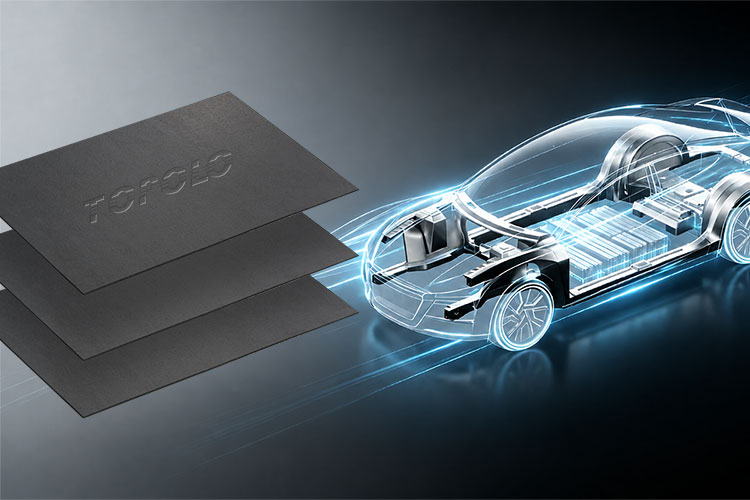
Protecting the vehicle underbody has long been a challenge for automotive manufacturers. Underbody components are exposed to road debris, stones, water, mud, vibration, and temperature variations, while they are also expected to remain lightweight and durable. This challenge has become even more important with the rapid development of electric vehicles (EVs). EVs carry large and heavy battery packs, making vehicle lightweighting an increasingly important strategy for improving energy efficiency, driving range, and overall vehicle performance. As thermoplastic composite technology continues to mature, more automotive manufacturers are adopting lightweight thermoplastic composite materials for underbody shields and other structural and protective components.
TOPOLO Thermoplastic Composites
TOPOLO leverages advanced thermoplastic composite production and processing capabilities to provide customized material solutions for automotive manufacturers, component suppliers, and vehicle body manufacturers.Materials can be customized according to the requirements of different vehicle platforms and specific components, including thickness, size, fiber content, surface effect, color, and structural configuration.
TOPOLO has developed a high-performance battery pack protection material that combines two thermoplastic composites: CFRT (continuous fiber reinforced thermoplastic) and GMT (glass fiber mat reinforced thermoplastic), which is also often referred to as LWRT (lightweight reinforced thermoplastic) in automotive applications.
The Composite Boasts the Following Superior Features:
Significantly lighter than steel and aluminum shields, thermoplastic composite underbody shields reduce overall vehicle weight and energy consumption, directly contributing to extended driving range for new energy vehicles.
Effectively dispersing and absorbing impact loads caused by road debris, gravel, and obstacles, the material helps reduce the risk of damage to the underside of the battery pack and enhances the vehicle’s underbody safety margin.
Effectively protecting the battery enclosure from rainwater, muddy water, and de-icing salt, while helping slow down corrosion and aging of underbody components.
Helping shield the battery pack from radiant heat generated by the road surface, reducing heat buildup under high-temperature conditions and supporting effective battery thermal management.

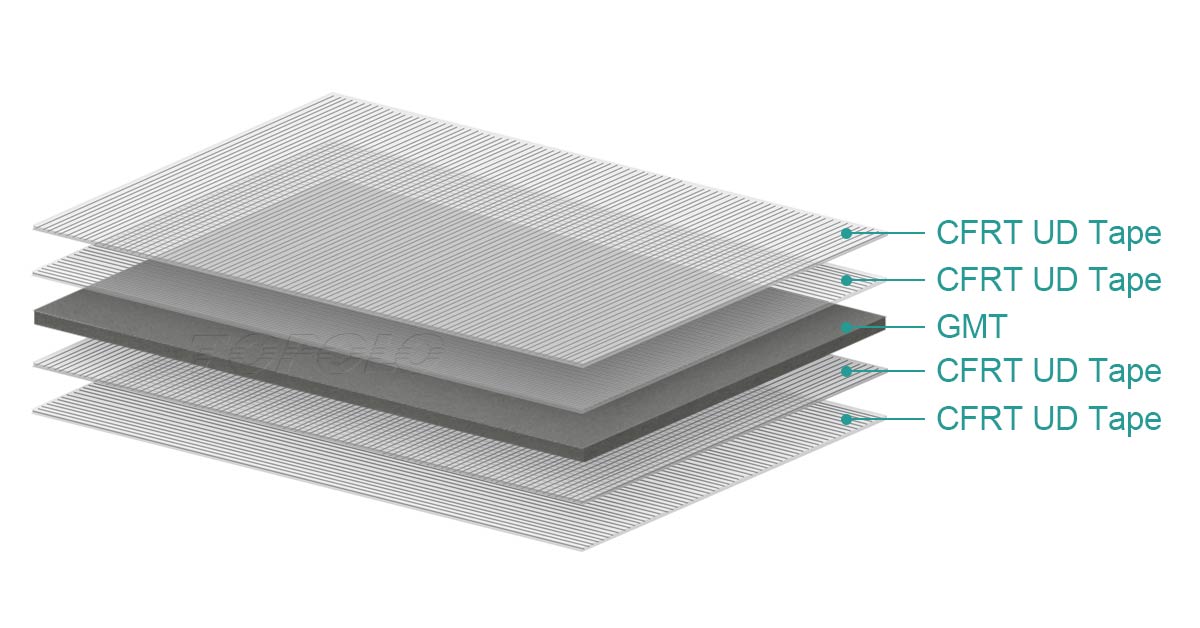
Composite Material Structure Analysis
- CFRT (Continuous Fiber Reinforced)
High flexural strength and excellent wear resistance create a robust outer protective barrier, effectively resisting impacts from road debris and gravel, abrasion from mud and sand, and surface scratches.
- GMT / LWRT (Glass Fiber Mat Reinforced)
Combining the high strength of glass fibers with the toughness of the thermoplastic matrix, GMT / LWRT significantly enhances the material’s energy and vibration absorption capabilities while providing excellent formability for complex geometries.
Excellent Secondary Processing Performance
- Excellent Thermoformability
Thermoplastic materials offer excellent secondary thermoformability when heated, enabling rapid press forming of complex curves and three-dimensional structures while significantly reducing production cycle times.
- Excellent Machinability
The material supports high-precision CNC cutting, drilling, trimming, and edge processing, meeting diverse requirements for mounting holes, dimensional accuracy, and assembly tolerances.