
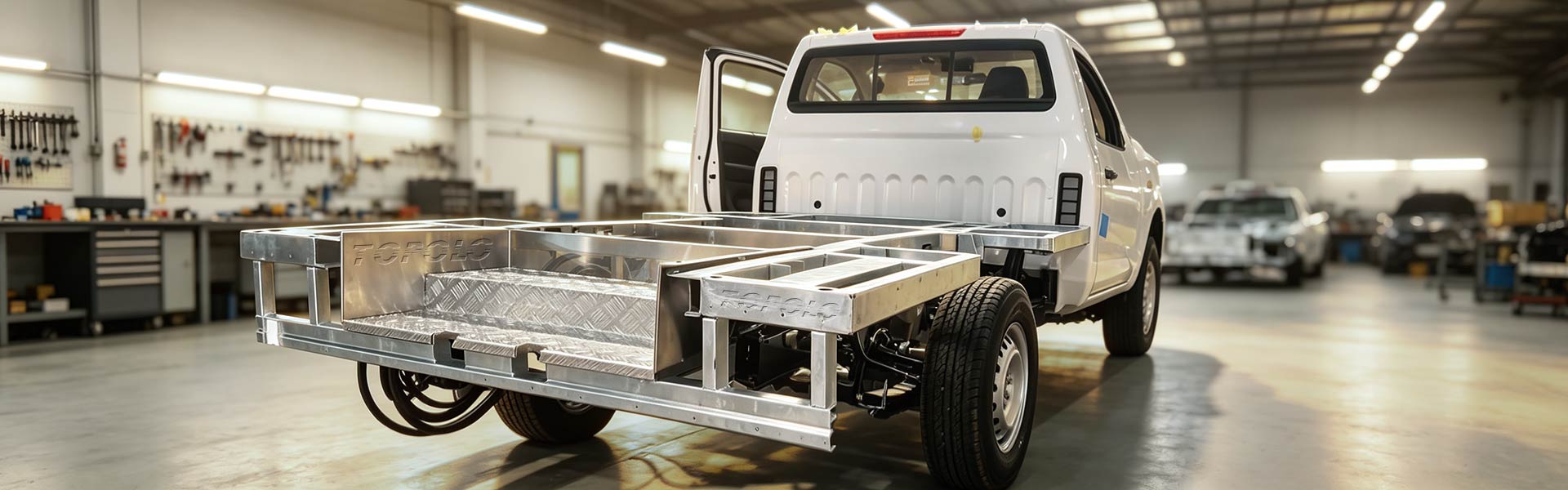
Universal Ambulance Subframe Platform
Suitable for Ford, Isuzu, Nissan, and Toyota pickup chassis
A Standardized Structural Foundation for Modular Ambulance Bodies
An ambulance subframe is the structural interface between the original vehicle chassis and the modular ambulance body. TOPOLO has developed a universal ambulance subframe platform that can support four to six selected Ford, Isuzu, Nissan and Toyota pickup chassis within a defined engineering compatibility range. Instead of redesigning the complete subframe for every ambulance conversion project, the platform combines a standardized load-bearing structure with chassis-specific interface components. This engineering approach is intended for ambulance body builders, ambulance conversion manufacturers, chassis suppliers, hospitals, EMS operators and emergency vehicle fleet owners seeking a safer, faster and more repeatable method of building pickup-based ambulances. The universal ambulance subframe is also the first step toward a broader objective: standardizing the modular ambulance body, composite floor, access ramp, entry steps and body-to-chassis installation system.
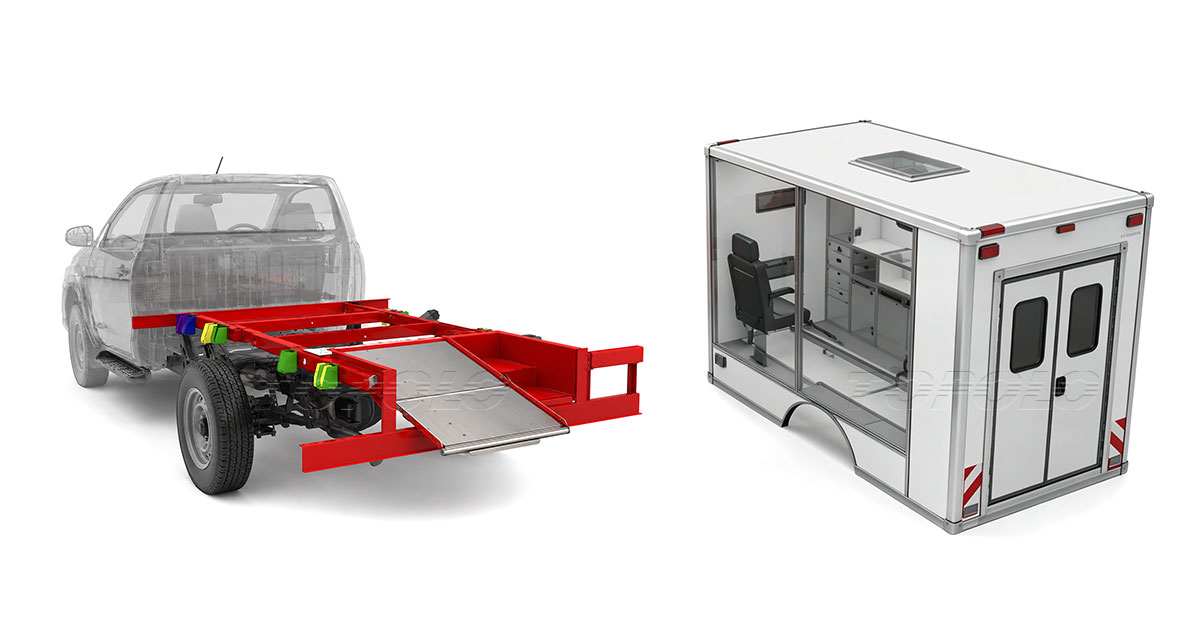
One Platform, Multiple Chassis, One Standardized Ambulance Body Interface
A pickup-based ambulance may appear similar from one project to another, but the underlying chassis dimensions are rarely identical. The TOPOLO universal ambulance subframe platform changes the development process from repeatedly designing one frame for one chassis to building a controlled platform for multiple approved chassis configurations.
The value of this approach is not limited to faster production. It provides a foundation for:
- More consistent ambulance body quality;
- Better structural load distribution;
- Reduced repeated engineering;
- More predictable local assembly;
- Standardized body modules;
- Lower manufacturing complexity;
- Improved maintenance support;
- More efficient CKD and SKD ambulance programs.
An ambulance subframe is the foundation of the complete vehicle body system. When that foundation is standardized and correctly engineered, the ambulance body, floor, access systems and local assembly process can also become more efficient and repeatable.
Why Ambulance Conversion Manufacturers Repeatedly Redesign the Subframe
Ford, Isuzu, Nissan and Toyota pickup chassis can differ in:
- Chassis rail width and section geometry;
- Wheelbase and rear overhang;
- Original body mounting points;
- Cab-to-axle distance;
- Rear axle and tire movement envelope;
- Fuel tank and fuel filler position;
- Exhaust and after-treatment system layout;
- Battery, spare wheel and suspension arrangement;
- Gross vehicle weight and axle load limits;
- Left-hand-drive and right-hand-drive configurations.
Under the traditional custom ambulance conversion model, each new chassis requires measurement, three-dimensional modeling, subframe redesign, new drawings, new fixtures and repeated prototype work. Even when the ambulance body dimensions remain unchanged, the complete mounting structure may have to be redesigned.
This creates several problems for an ambulance body builder:
- Engineering work begins again with every new chassis.
- Production cannot start until the chassis arrives and is measured.
- Urgent orders create pressure on design, purchasing and fabrication.
- Different projects use different components and installation procedures.
- Quality consistency depends heavily on the experience of individual engineers and welders.
- The manufacturer cannot easily keep ambulance subframes in stock.
- Future repairs and chassis replacement become more complicated.
The problem is therefore not limited to cost. It affects delivery time, repeatability, structural quality, maintenance and long-term vehicle safety.
What Is a Universal Ambulance Subframe?
A universal ambulance subframe is not one fixed steel frame that is installed indiscriminately on every vehicle. It is an engineered platform consisting of three functional levels:
- A standardized primary load-bearing structure;
- Chassis-specific interface and mounting components;
- A standardized upper interface for the modular ambulance body.
The main load-bearing frame remains substantially consistent across the approved chassis range. Differences between individual pickup chassis are managed through controlled interface components and project-specific installation configurations.
This allows TOPOLO to establish a common structural foundation for different Ford ambulance chassis, Isuzu ambulance conversions, Nissan pickup ambulances and Toyota pickup ambulance bodies, while still respecting the original vehicle manufacturer’s chassis limitations.
The platform can accommodate variations such as:
- Different wheelbases within the approved design range;
- Left-hand-drive or right-hand-drive vehicles;
- Left-side or right-side wheelchair ramps;
- Different side-door arrangements;
- Fuel tanks and filler ports on different sides;
- Different tire and axle positions;
- 4×2 or 4×4 chassis configurations;
- Rear entry steps and serviceable access modules.
Every chassis model must still undergo a compatibility review. Universalization means standardizing the repeatable part of the engineering work, not eliminating engineering verification.
Why the Ambulance Chassis Subframe Is Critical to Vehicle Safety
The ambulance subframe is much more than a support used to hold the box body above the chassis.
A complete ambulance load path can include:
Patient, medical crew and equipment → seats, restraints and stretcher systems → ambulance floor and local reinforcement → modular ambulance body → ambulance subframe → chassis mounting interfaces → original chassis rails.
If any part of this load path is weak, incorrectly located or poorly connected, the result may include:
- Cracking around body mounting points;
- Local deformation of the ambulance floor;
- Loosening of seat or stretcher anchors;
- Excessive body movement relative to the chassis;
- Fatigue cracking after long-term road use;
- Damage to the original chassis rails;
- Increased risk during emergency braking or collision;
- Higher repair costs after years of service.
An ambulance may appear structurally sound when it leaves the factory but still develop problems after repeated braking, road impact, chassis twisting, corrosion and equipment loading.
For this reason, TOPOLO treats the ambulance body mounting system, floor structure, stretcher anchorage, seat mounting areas and chassis subframe as parts of one structural system rather than unrelated components.
Designed from Long-Term Ambulance Use and Maintenance Feedback
The TOPOLO universal ambulance subframe platform was developed using field feedback, maintenance observations and structural problem records accumulated through multiple customer projects over nearly a decade.
The purpose of this work was not simply to make the frame heavier. The objective was to identify where an ambulance chassis subframe normally experiences:
- Repeated tensile stress;
- Torsional fatigue;
- Local stress concentration;
- Weld fatigue;
- Mounting-point deformation;
- Impact loading;
- Corrosion damage;
- Unnecessary structural weight.
Areas with a higher risk of cracking or fatigue are reinforced through controlled structural design. Areas carrying lower stress can be optimized to reduce unnecessary mass.
This creates a more disciplined balance between ambulance lightweighting, structural strength and long-term durability.
Detailed steel specifications, section dimensions, interface coordinates, welding details, analysis models and project-specific validation data are controlled engineering documents. They are provided after the exact chassis, body configuration and target market requirements have been confirmed.
A High-Strength Subframe for Off-Road and Mountain Rescue Ambulances
A conventional urban ambulance and an off-road ambulance do not experience the same operating conditions.
Ambulances used for mountain rescue, forest rescue, mining operations, remote medical services, rural hospitals and disaster response may travel on uneven roads where the left and right wheels move through significantly different vertical positions. This causes the chassis to twist repeatedly.
The subframe for a 4×4 ambulance must therefore manage more than vertical body weight. It must also consider:
- Chassis torsion;
- Road impact;
- Emergency braking;
- Lateral acceleration;
- Repeated vibration;
- Rear overhang loading;
- Equipment and occupant inertia;
- Long-term fatigue;
- Mud, water, salt and stone impact.
A frame that is extremely rigid but incorrectly connected can transfer excessive stress into a small number of original chassis mounting points. A frame that is too flexible may allow excessive movement of the ambulance body.
The correct engineering objective is to distribute loads across approved chassis interfaces while controlling relative movement between the pickup chassis, ambulance subframe and modular ambulance body.
This is particularly important for 4×4 ambulances, off-road rescue vehicles and rural emergency ambulances, where long-term torsional durability may be more critical than the initial static load result.
High-Strength Steel and Long-Term Corrosion Protection
The universal ambulance chassis subframe uses a welded high-strength steel structure combined with hot-dip galvanized surface protection.
Material selection is based on more than nominal yield strength. The design must also consider:
- Weldability;
- Structural ductility;
- Fatigue behavior;
- Local buckling resistance;
- Impact performance;
- Heat-affected-zone properties;
- Compatibility with the galvanizing process;
- Long-term performance after corrosion exposure.
Hot-dip galvanizing provides protection for external surfaces and accessible internal areas of the fabricated structure. The actual corrosion service life depends on environmental classification, coating condition, road salt exposure, mechanical damage and maintenance practices.
For ambulance body builders operating in coastal regions, humid climates, mining sites or areas where road salt is used, corrosion protection is not a cosmetic requirement. It is part of the long-term structural design.
The objective is to prevent corrosion from gradually reducing the effective wall thickness and fatigue strength of the ambulance subframe over years of service.
How the Universal Platform Supports Different Pickup Chassis
The TOPOLO platform is designed around a defined compatibility envelope rather than one unrestricted claim of universal fitment.
| Chassis variable | Platform response |
| Different chassis rail widths | Chassis-specific interface configuration |
| Different body mounting points | Dedicated mounting interface for the approved model |
| Different wheelbases | Position adjustment within the validated platform range |
| Different fuel tank locations | Configurable clearance and access arrangement |
| Different left/right filler positions | Corresponding body and floor access design |
| Different tire envelopes | Wheel and suspension clearance review |
| Left-hand drive or right-hand drive | Symmetrical or configurable body functions |
| Left-side or right-side wheelchair ramp | Configurable ramp and floor reinforcement |
| 4×2 or 4×4 chassis | Chassis-specific clearance and torsion assessment |
| Different rear steps | Modular and serviceable step arrangement |
The platform can therefore support selected models from Ford, Isuzu, Nissan and Toyota without redesigning the complete ambulance body mounting system for every order.
However, chassis model year, cab type, drive configuration, gross vehicle weight, axle capacities and original manufacturer body-builder instructions must still be verified for each project.
From Custom Fabrication to a Standard Ambulance Subframe
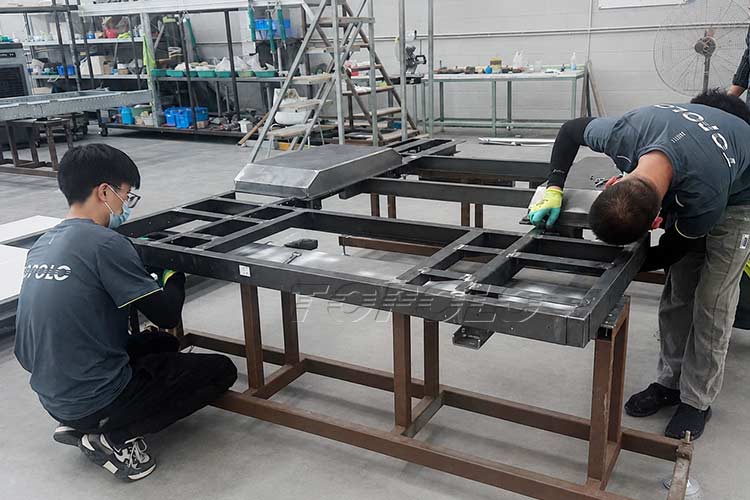
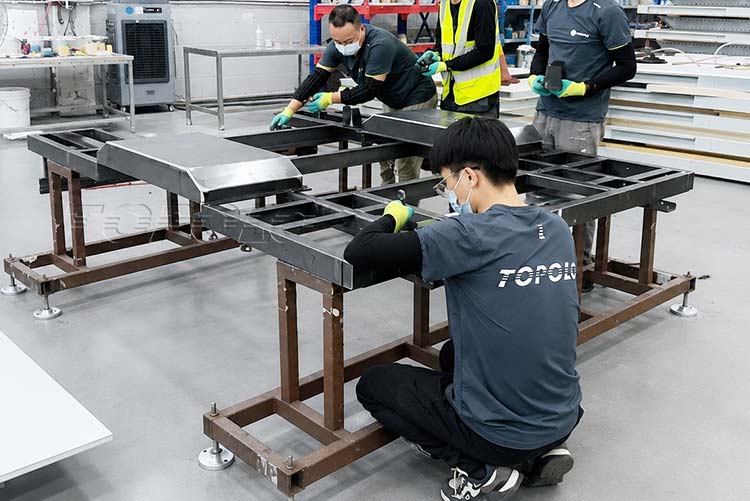
The most important manufacturing advantage of the universal platform is the ability to convert the primary ambulance subframe into a repeatable production item.
Once a structure has been standardized, the ambulance conversion manufacturer can:
- Use stable manufacturing fixtures;
- Establish repeatable welding and dimensional controls;
- Purchase materials in larger batches;
- Prepare common components in advance;
- Reduce urgent engineering changes;
- Maintain selected subframes or interface components in stock;
- Improve spare-parts management;
- Shorten the time between order confirmation and body installation.
The ambulance body builder no longer begins every order from an empty drawing. The project begins with a validated platform and then proceeds through chassis selection, interface confirmation and configuration review.
This is a fundamental shift from one chassis, one design to one platform, multiple approved chassis configurations.
Why Standardizing the Subframe Helps Standardize the Ambulance Body?
The subframe defines the installation plane, load path and lower dimensional boundary of the ambulance body.
When these interfaces remain consistent, the following components can also be progressively standardized:
- Modular ambulance body structure;
- Side, roof, floor and door modules;
- One-piece composite floor;
- Stretcher and seat reinforcement zones;
- Ramp and entry-step interfaces;
- Electrical and service routing areas;
- Body fastening and sealing methods;
- CKD and SKD ambulance body kits.
TOPOLO can integrate the universal subframe with a one-piece insulated composite floor. The floor can combine thermal insulation, water resistance, noise reduction and structural integration while reducing the number of joints assembled at the customer’s factory.
Local reinforcement for seats, safety belts, stretchers, wheelchair restraints and heavy medical equipment must still be designed as part of the complete load path.
The result is not simply a steel frame beneath a box. It is a coordinated ambulance body system designed for faster local assembly and more repeatable production.
Benefits for Ambulance Body Builders and Local Assembly Partners
For an ambulance conversion manufacturer or local ambulance assembly plant, a standardized platform can produce measurable operational benefits.
| Business area | Potential benefit |
| Engineering | Less repeated design work for each chassis |
| Production | Stable fixtures and repeatable assembly procedures |
| Purchasing | Fewer unique components and larger batch quantities |
| Inventory | Ability to stock common frames and body modules |
| Delivery | Earlier production before the chassis reaches the factory |
| Quality | Reduced variation between projects |
| Training | Easier operator and installer training |
| Maintenance | More standardized replacement components |
| Local assembly | Suitable for CKD and SKD ambulance body programs |
| Cost | Lower unit cost as production volume increases |
This model is particularly suitable for regional ambulance manufacturers that purchase different pickup chassis according to local availability but want to maintain one consistent ambulance body family.
Benefits for Chassis Manufacturers and Commercial Vehicle Dealers
Chassis manufacturers and commercial vehicle dealers often need reliable body builders capable of converting their vehicles into ambulances without compromising the original chassis.
A universal ambulance body platform can provide:
- A clearer chassis-to-body engineering interface;
- Faster development of ambulance demonstration vehicles;
- Greater compatibility with regional chassis availability;
- Reduced repeated engineering between the chassis supplier and body builder;
- A standardized body solution across several markets;
- Better documentation for local assembly partners;
- More predictable after-sales support.
For a chassis supplier, the value is not only selling the base vehicle. It is creating a complete and repeatable ambulance chassis solution that local body builders, hospitals and emergency services can adopt.
How Should a Hospital Choose an Ambulance Body?
Hospitals and EMS organizations frequently compare engine power, medical equipment and purchase price, but the structure between the chassis and the ambulance body is often overlooked.
When selecting an ambulance, a hospital or fleet operator should ask the following questions:
1. Is the ambulance body engineered for the exact chassis?
The supplier should identify the chassis brand, model year, wheelbase, drive type and vehicle weight limits. A generic statement that the body “fits the chassis” is insufficient.
2. How is the ambulance body mounted?
The buyer should understand whether the body mounting system distributes loads across approved chassis points and whether the installation follows the original chassis manufacturer’s conversion instructions.
3. Have axle loads and vehicle mass been evaluated?
A complete ambulance includes medical staff, patients, stretchers, oxygen systems, cabinets, batteries, air-conditioning equipment and emergency equipment. The finished vehicle must remain within its applicable gross vehicle and axle load limits.
4. How are seats, safety belts and stretchers connected to the structure?
These components should not rely only on a thin decorative floor panel. Their loads must be transferred through reinforced zones into the ambulance body and subframe.
5. Is the ambulance suitable for the actual road conditions?
An urban patient-transfer ambulance and a 4×4 mountain rescue ambulance require different levels of torsional durability, ground clearance, corrosion protection and impact resistance.
6. What corrosion protection is provided?
Hospitals operating near the sea, in humid regions or on salted roads should request information about subframe corrosion protection and damaged-coating repair procedures.
7. Can the body be repaired or remounted?
A modular ambulance body and standardized subframe interface can simplify future repair or chassis replacement assessment, although every remount still requires structural and compatibility review.
The lowest initial price does not necessarily produce the lowest lifetime operating cost. A hospital should evaluate the ambulance chassis, subframe, body, floor, interior restraints and maintenance system as one vehicle.
Ambulance Safety Standards and Structural Testing
Road ambulance requirements differ between countries. The applicable regulatory path must be confirmed according to the final registration market, chassis, ambulance category and customer specification.
For European projects, EN 1789:2020+A1:2023 addresses the design, testing, performance and equipping of road ambulances, including the working environment and safety of patients and crew.
For North American and other projects that reference SAE test methods, relevant subjects can include:
| Standard | Main subject |
| SAE J3026 | Patient-compartment seating and occupant restraints |
| SAE J3027 | Patient stretcher, retention and restraint system |
| SAE J3043 | Medical and emergency equipment mounting systems |
| SAE J3057 | Modular ambulance body structural evaluation |
| SAE J3102 | Floor and substructure integrity supporting the stretcher system |
CDC/NIOSH identifies ten SAE ambulance test methods covering seat belts, stretcher and floor mounting, equipment restraint, modular body integrity, cabinets and crash-related structural behavior. These methods allow builders and component suppliers to evaluate ambulance safety as a connected system.
A universal ambulance subframe does not automatically certify every completed vehicle. Final compliance depends on:
- The selected chassis;
- Ambulance body size and mass;
- Interior arrangement;
- Seat and stretcher systems;
- Equipment locations;
- Target-country regulations;
- Test configuration;
- Final-stage manufacturer responsibilities.
TOPOLO therefore uses standards as engineering inputs and confirms the required validation route for each project. Statements such as “tested,” “compliant” or “certified” should always refer to a defined vehicle configuration, standard edition and supporting document.
Lightweighting Must Not Replace Safety and Durability
Reducing ambulance weight can improve payload, fuel consumption and axle-load distribution. However, reducing material thickness without understanding the load path can create fatigue and durability problems.
A safe lightweight ambulance subframe requires selective optimization:
- Reinforce areas exposed to high tensile or fatigue stress;
- Reduce unnecessary weight only in lower-stress regions;
- Maintain sufficient ductility and impact resistance;
- Avoid abrupt stiffness transitions;
- Control weld locations and manufacturing consistency;
- Consider corrosion after years of service;
- Verify the combined chassis, subframe and body behavior.
The correct objective is therefore not the lightest possible frame. It is the lowest practical mass that still provides the required strength, fatigue durability, corrosion resistance and safety margin.
For emergency vehicles, long-term structural integrity is more important than a small reduction in initial weight.
A Complete Modular Ambulance Body Solution
TOPOLO is not limited to supplying a standalone ambulance chassis subframe.
Depending on the project, TOPOLO can provide:
- Universal or chassis-specific ambulance subframes;
- Complete modular ambulance bodies;
- Box ambulance body structures;
- One-piece composite ambulance floors;
- Side, roof, floor and door modules;
- Wheelchair ramps and access steps;
- Lightweight composite sandwich panels;
- CKD ambulance body kits;
- SKD ambulance body systems;
- Engineering support for local assembly;
- Chassis and body compatibility review.
This allows an ambulance conversion manufacturer to select a supply model according to its own capabilities.
A mature body builder may purchase the subframe, composite panels and structural modules. A new local assembly partner may require a more complete CKD ambulance body kit, installation documentation and engineering support.
The objective is to combine TOPOLO’s body engineering, lightweight materials, manufacturing system and supply chain with the customer’s local chassis sourcing, final assembly, certification, sales and after-sales service.
Information Required for an Ambulance Chassis Compatibility Review
To determine whether a chassis falls within the existing universal ambulance subframe platform, the following information should be provided:
- Chassis manufacturer and exact model;
- Model year;
- Single-cab, extended-cab or double-cab configuration;
- 4×2 or 4×4 drive system;
- Wheelbase;
- Gross vehicle weight rating;
- Front and rear axle ratings;
- Chassis drawing or body-builder guide;
- Planned ambulance body length, width and height;
- Left-hand drive or right-hand drive;
- Side-door and rear-door arrangement;
- Wheelchair ramp position;
- Fuel filler location;
- Intended number of seats and stretchers;
- Main medical equipment;
- Target sales country;
- Required ambulance standard or tender specification.
After this information is reviewed, TOPOLO can determine whether the project uses an existing platform configuration, requires a new interface package or needs a separate engineering solution.
Detailed interface drawings, structural specifications and validation documents are supplied through the controlled project engineering process.
Frequently Asked Questions
What is an ambulance subframe?
An ambulance subframe is the structural assembly installed between the original vehicle chassis and the modular ambulance body. It distributes body, occupant and equipment loads into the approved chassis mounting locations.
Can one ambulance body fit different pickup chassis?
Yes, a standardized ambulance body can be adapted to several pickup chassis when the lower mounting system uses a common structural platform and chassis-specific interfaces. Each chassis must still be reviewed for dimensions, weight limits, mounting points and interference.
Can the TOPOLO platform fit Ford, Isuzu, Nissan and Toyota pickup chassis?
The platform is designed to support selected Ford, Isuzu, Nissan and Toyota pickup chassis within an approved engineering range. The exact model, year, wheelbase and drive configuration must be confirmed before compatibility is approved.
Is the universal ambulance subframe suitable for a 4×4 ambulance?
It can be configured for selected 4×4 ambulance and off-road rescue projects. Chassis torsion, suspension movement, ground clearance, rear overhang and operating terrain must be considered.
Can the wheelchair ramp be installed on either side?
The platform can support left-side or right-side access configurations, subject to the ambulance body layout, chassis components and target-market requirements.
Does the subframe comply with EN 1789 or SAE ambulance standards?
The platform can be engineered as part of projects targeting EN 1789 or relevant SAE ambulance test methods. Final compliance applies to a defined completed vehicle and cannot be confirmed from the subframe alone.
Can TOPOLO supply the complete ambulance body?
Yes. TOPOLO can provide the subframe, modular ambulance body, composite floor, body panels, door modules, ramp and CKD or SKD body systems according to the project scope.
What should a hospital check before buying an ambulance?
The hospital should review chassis capacity, axle loads, body-to-chassis mounting, structural testing, seat and stretcher anchorage, corrosion protection, maintenance access and suitability for the actual road environment.
For a chassis compatibility review or complete modular ambulance body proposal, provide the chassis model, model year, wheelbase, vehicle weight ratings, body dimensions and target ambulance standard to the TOPOLO Engineering Team.