
Home » Building & Construction Solutions
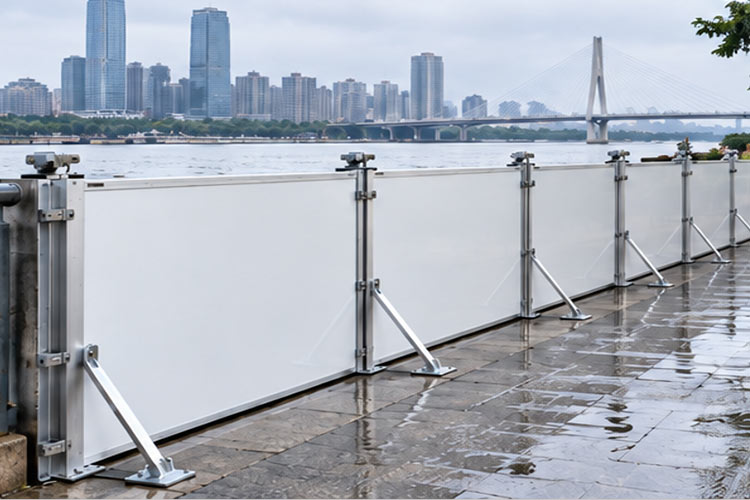
Flood barrier walls play a crucial role in protecting urban infrastructure, transportation networks, residential areas, and commercial zones from rising floodwaters, storm surges, and flash floods. They are widely deployed at subway entrances and exits, underpasses, tunnels, high-speed railway stations, riverbanks, building entrances, and other areas vulnerable to flooding. Among various flood-control solutions, demountable and portable flood barriers are gaining increasing attention due to their flexibility, ease of installation, and rapid deployment capabilities. In the event of a sudden flood, these modular barrier systems can be quickly assembled to form temporary protective walls, effectively blocking the encroachment of floodwaters and minimizing potential damage.
The performance of portable flood barriers depends largely on the material used for their water-retaining panels
Traditional metal flood panels are often heavy, which increases the physical effort required for handling and installation. Furthermore, these metal panels can undergo permanent deformation when subjected to excessive loads. Issues such as corrosion and sealing challenges can also compromise their long-term performance. To overcome these limitations, TOPOLO has developed thermoplastic honeycomb composite panels, offering an innovative alternative to traditional metal flood panels. Combining a lightweight structure with excellent water resistance and high mechanical strength, these composite panels provide a practical material solution for modern, demountable flood protection systems.
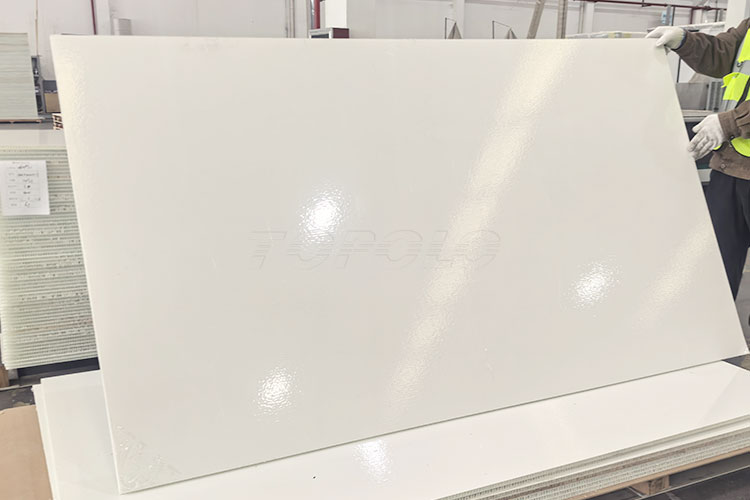
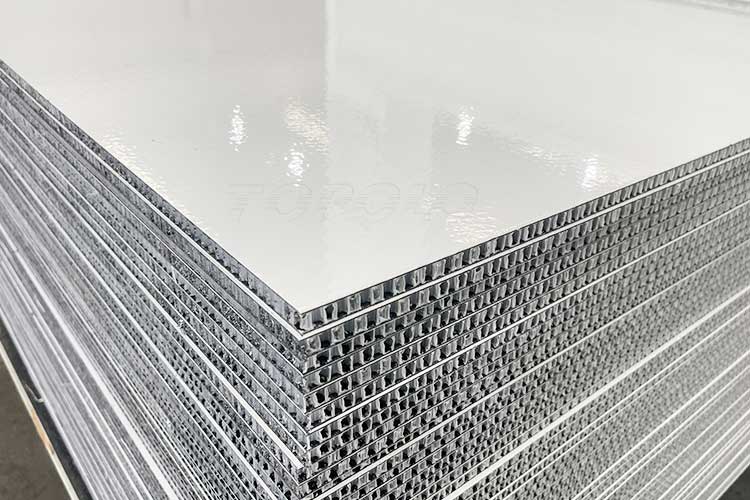
TOPOLO Thermoplastic Honeycomb Composite Panels
Thermoplastic honeycomb composite panels are an advanced type of sandwich-structured composite material. They are manufactured using a thermal lamination process that bonds skins made of continuous fiber-reinforced thermoplastic (CFRT) composites to a polypropylene (PP) honeycomb core.

The outer CFRT skins provide strength, rigidity, and impact resistance, while the internal polypropylene honeycomb core creates a lightweight panel with high structural efficiency. Unlike traditional sandwich panels, which rely on adhesives to join different material layers, TOPOLO utilizes a thermal lamination process that fuses compatible thermoplastic materials together through heat.
The use of flood barriers with a honeycomb panel structure offers several significant advantages.
- Lightweight structure for rapid deployment
Thermoplastic honeycomb composite panels significantly reduce both material usage and the overall weight of the panels. In the event of an emergency flood situation, the flood barriers can be transported, positioned, and installed in the shortest possible time.
- Excellent water resistance, suitable for damp environments
Flood barriers are frequently exposed to rain, standing water, and prolonged damp conditions. Consequently, water resistance is one of the most critical requirements for the materials used in these barriers. Thermoplastic honeycomb composite panels are manufactured using highly water-resistant thermoplastic materials, making them suitable for long-term immersion in water.
- High-strength structure for effective resistance against water pressure
Flood barriers must be capable of withstanding significant hydrostatic pressure, especially when floodwater levels continue to rise. TOPOLO thermoplastic honeycomb composite panels feature skins reinforced with continuous fibers, which enhance the material’s tensile strength, flexural strength, and overall rigidity. This allows for a superior strength-to-weight ratio without the need for heavy, solid structures.
- Material Recyclability
From an environmental protection perspective, these thermoplastic honeycomb panels are recyclable; both the polypropylene honeycomb core and the thermoplastic skins can be processed using thermoplastic material recycling methods.
Get a custom flood barrier solution
TOPOLO thermoplastic honeycomb composite panels can be easily cut and processed using appropriate industrial cutting equipment. This allows manufacturers the flexibility to customize panel dimensions according to the design requirements of various flood-control barriers.