

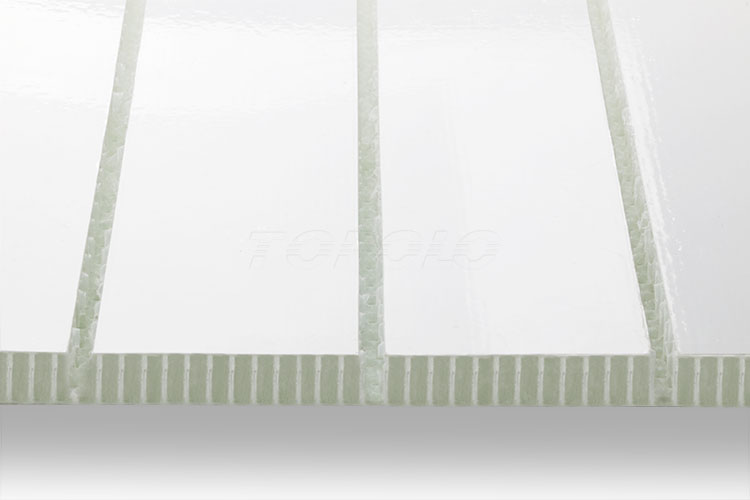
Specifications
- Total Thickness: Customized: 10 – 50mm
- Length: ≤12m.
- Width: ≤2.8m.
- Facing: 1.2mm CFRT sheet. (Customized: 0.7 – 2.0mm)
- Core Layer: 100kg/m³ PP (polypropylene) honeycomb. (Customized: 60-160 kg/m³)
Description
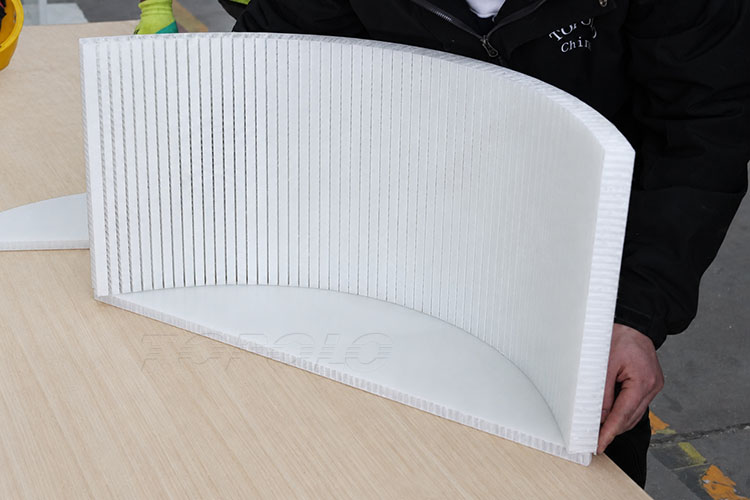

Bending Principle
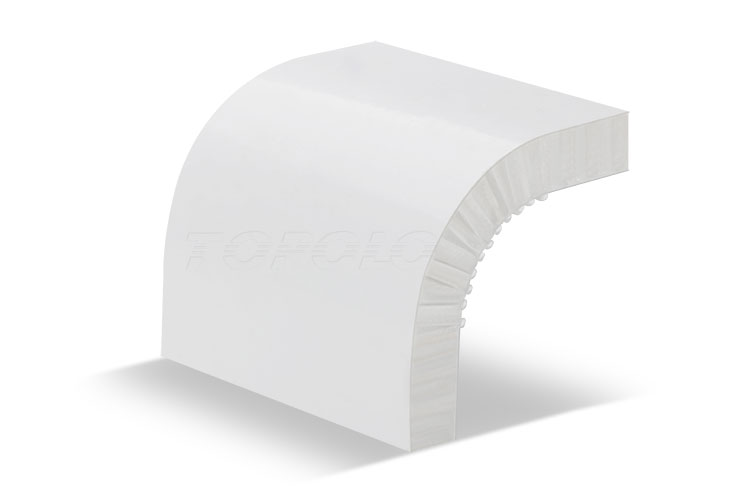
For box-body structures requiring curved designs, transforming a flat sandwich panel into a stable curved structure presents a manufacturing challenge. Thanks to the thermoplastic properties of polypropylene, PP honeycomb core composite panels can be shaped into curves using a “grooving and thermal welding” process. This technique allows flat panels to be bent to a specific radius while maintaining structural stability after forming. This bendable honeycomb panel solution is widely used in applications requiring lightweight curved structures, including caravans, camping trailers, cargo boxes, and other specialized vehicle bodies.

How is the bending of PP honeycomb panels achieved?
The curved forming process primarily involves two steps: grooving and thermal welding.
- Grooving
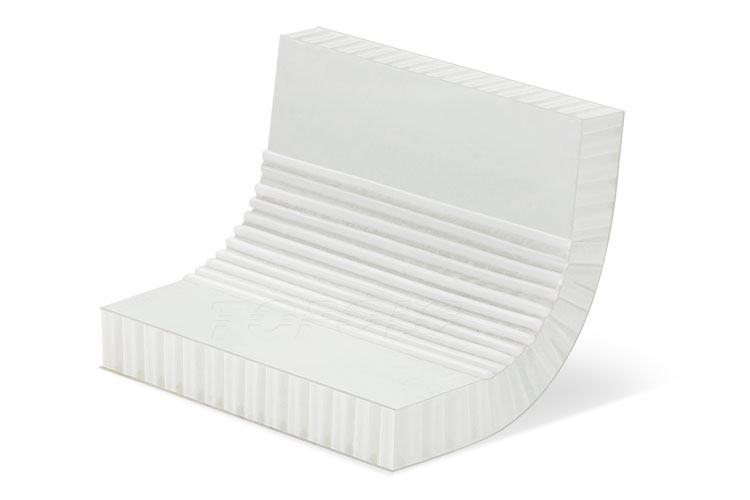
A groove of a specific depth is cut into the thermoplastic honeycomb composite panel at the location where bending is required. The depth and width of the groove are designed based on the desired bending radius and curvature. By selectively removing a portion of the panel structure, the panel can bend more easily along the predetermined line while maintaining the structural integrity of the remaining core.
- Thermal welding
After grooving, the panel is bent into the desired curved shape, and the seam at the groove is thermally welded using a polypropylene welding rod. The resulting weld secures the panel’s curved shape and creates a stable connection between the bent sections. Since both the panel and the welding material are based on thermoplastic polypropylene, thermal welding creates a strong, integrated bond without the need for traditional adhesives.