Underwater FRP (Fiberglass) Pile Jackets
Home » Building & Construction Solutions
Why Piles Require Rehabilitation?
Concrete piles, bridge piers, marine piles, utility poles, and steel structural columns are often exposed to underwater, wet, salt-spray, or marine environments for extended periods. They are highly susceptible to continuous deterioration caused by moisture, chloride ions, chemicals, and freeze-thaw cycles. Over time, these structures may develop cracks, concrete spalling, reinforcement corrosion, and cross-sectional loss. The problem is particularly severe for pile foundations of bridges, piers, offshore platforms, and port facilities, which remain submerged in water for long periods and are extremely difficult to access, inspect, maintain, and reinforce. Progressive deterioration can significantly reduce the load-bearing capacity and service life of the structure while increasing long-term maintenance and repair costs.
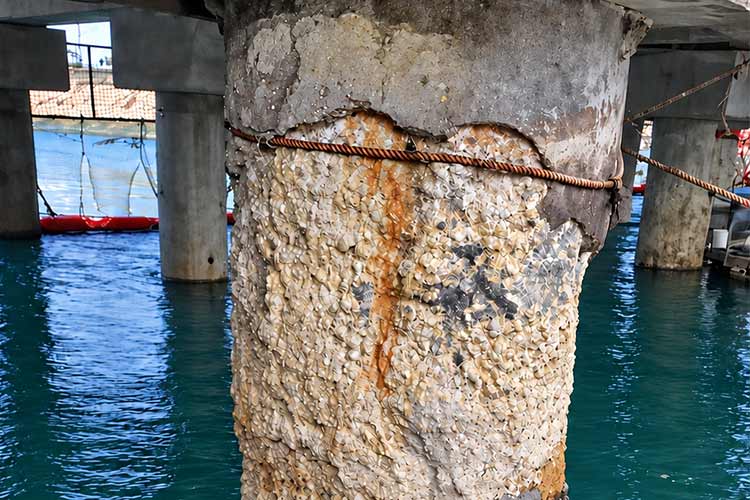
Common pile damage includes:
Due to factors such as freeze-thaw cycles, temperature changes, load effects, and internal stress, longitudinal, transverse, or irregular cracks may appear on the pile surface.
The protective layer may gradually loosen and peel off after long-term exposure to water flow, freeze-thaw cycles, and chemical erosion, resulting in localized defects and voids in severe cases.
Chloride ions and moisture penetrate the concrete, damaging the passivation layer on the reinforcing steel surface and causing corrosion. The internal pressure generated by the expansion of corrosion further leads to concrete cracking and spalling.
Long-term corrosion, erosion, and mechanical damage may cause localized material loss in the pile, gradually reducing the effective cross-section.
Continuous water flow, waves, and tides may cause erosion of the soil around the pile, resulting in localized hollowing-out and affecting the stability of the pile foundation.
Ship collisions, impacts from floating objects, and mechanical damage during construction can all cause localized cracking, breakage, or even severe defects in the pile.
Steel pipe piles and steel structural columns are prone to corrosion, pitting, and localized cross-sectional loss when exposed to seawater, salt spray, and humid environments for extended periods.
Timber piles exposed to humid, underwater, or biologically active environments for extended periods may decay, soften, and experience a decrease in strength.
Traditional repair methods typically require complex formwork, rebar installation, underwater construction, and extensive diving operations. These processes lead to extended construction periods, increased labor costs, and higher maintenance expenses. Unlike steel plates, FRP (fiber-reinforced polymer) prevents rusting without the need for galvanizing or coating. Instead, it slows the rate at which corrosive media continuously penetrate the structure, thus delaying subsequent deterioration.
Flexible Woven Roving FRP Sheets
TOPOLO offers a lighter, more modular, and corrosion-resistant structural repair solution.

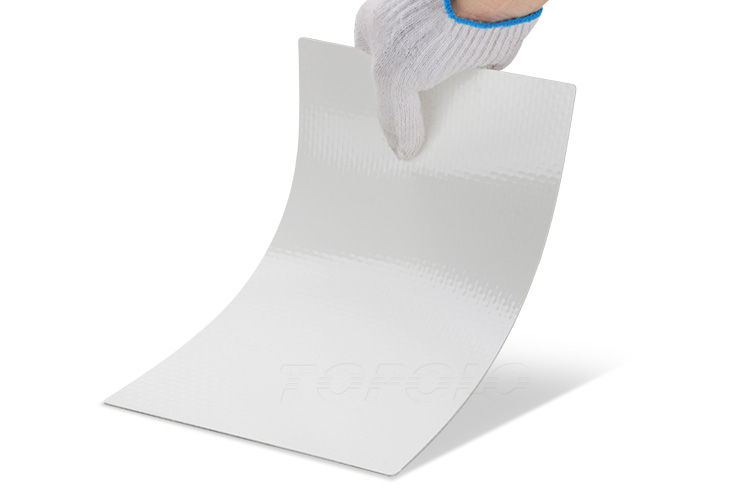
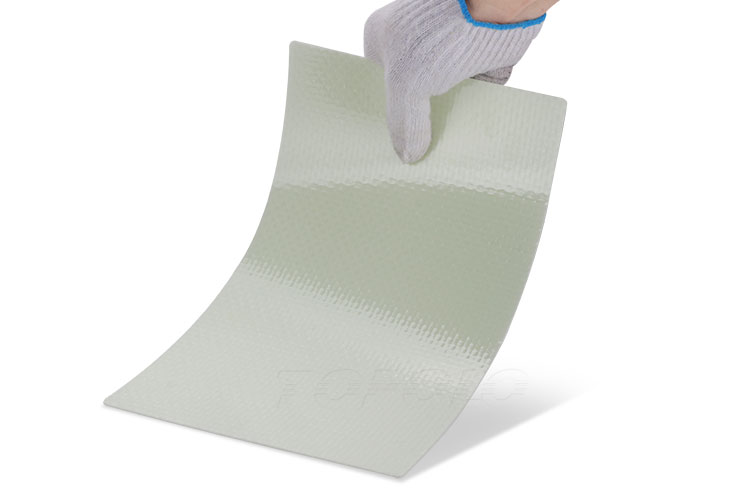
The FRP is a lightweight, high-strength, flexible glass fiber reinforced composite laminate designed for structural repair and reinforcement. This laminate is made by combining woven glass fiber cloth with high-performance vinyl ester resin, resulting in excellent tensile strength, corrosion resistance, and long-term durability. Compared to traditional unsaturated polyester FRP, vinyl ester-based FRP offers superior mechanical properties and greater resistance to harsh environments. Its lightweight and flexible structure allows for easy wrapping of piles, columns, and other structural members, making it particularly suitable for underwater and marine structural repair applications.
Reasons to Choose It
- Thin & Lightweight
- High Tensile Strength
- Flexible & Rollable
- Corrosion Resistant Water & Salt Spray Resistant
- Low Water Absorption
- UV Resistant
- Non-Conductive
- Easy to Install
Material Specifications
- Material: Woven fiberglass + vinyl ester resin
- Thickness: 1.5mm (customizable)
- Maximum Width: 1220-3200 mm
- Roll Length: 120 m/roll
How FRP Achieves Structural Strengthening?
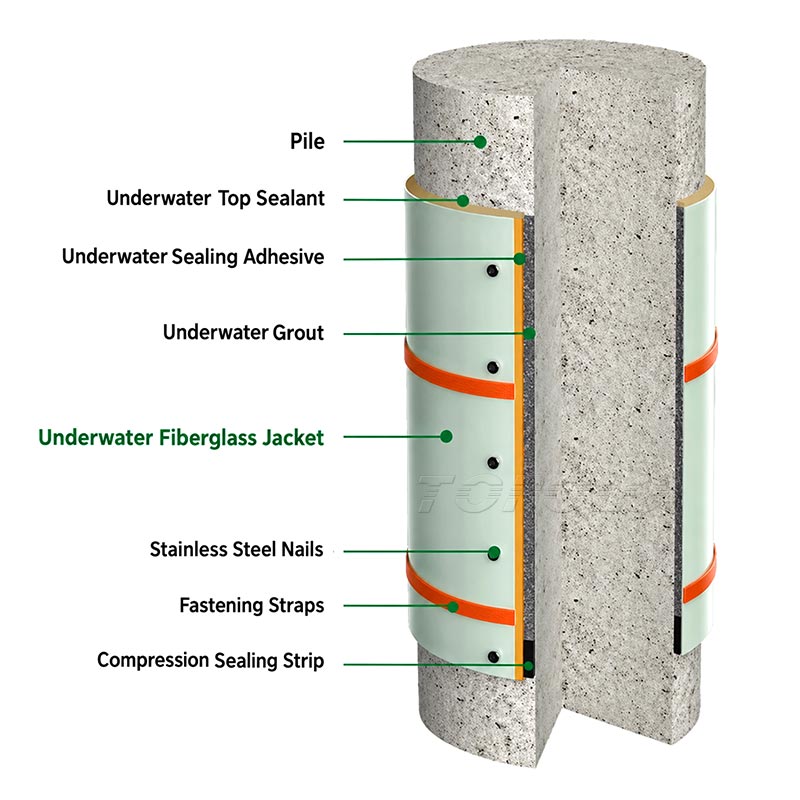
- An FRP sheet forms a continuous closed jacket around the pile structure.
- When the internal concrete is subjected to axial pressure, it tends to expand laterally.
- The FRP jacket provides restraint through circumferential tension, thereby limiting the lateral deformation of the concrete.

The FRP jackets can serve as both a permanent formwork and part of a long-term protection and structural reinforcement system. It can be manufactured in factories in the form of flat sheets or rolls, and on the construction site, they can be formed around the existing structure.
- Circular jackets.
- Elliptical jackets.
- Square or rectangular structural coverings.
- Irregular structural shells.
Then, a certain annular space is formed between the original structure and the FRP shell, and filled according to the engineering design with:
- High-strength non-shrink grout
- Epoxy grouting materials
- Polymer-modified mortar
- Underwater-specific grouting materials
- Concrete or other structural filling materials
The final result is: Existing Structure + Repair Grout + FRP Permanent Jacket.
Pile Structure Rehabilitation Process
- Inspect Pile Damage
First, inspect the pile for damage and determine the repair area based on the inspection results.
- Clean the Pile Surface
Remove any adhering substances and corroded areas.
- Install Spacers
Install positioning blocks around the original pile to create a ring-shaped grouting space.
- Wrap the FRP Jacket
Wrap the FRP jacket around the pile to form a continuous FRP shell.
- Seal the Jocket
Seal the top, bottom, and overlapping areas of the jocket to prevent grout loss.
- Secure the Jacket
After the jacket is in place, use steel nails and fastening straps to tighten and position it.
- Pump Grout
Inject grout material between the FRP Jacket and the original structure through the pre-drilled grouting port.